

Introduction
Imagine a world where AI in neuroscience can read brain signals, predict emotions, and even detect early signs of neurological disorders — long before symptoms appear.
However, that future is no longer science fiction. With the rise of artificial intelligence (AI), neuroscience has entered a groundbreaking era where algorithms are learning to decode the human brain.
AI is transforming how researchers understand the mind. From identifying subtle brainwave patterns to predicting mental health conditions, the collaboration between humans and machines is opening doors to discoveries once thought impossible.
Disclaimer: This article is for informational purposes only and is not a substitute for professional medical advice. If you have concerns about a neurological or mental health condition, consult a qualified healthcare provider.
What Is AI in Neuroscience?
At its core, AI in neuroscience means using computational algorithms to analyze brain data — such as neural activity, MRI scans, and behavioral responses — to reveal how the brain functions.
In the past, traditional neuroscience relied heavily on manual analysis and small data sets. But the human brain produces billions of data points every second.
That’s where AI comes in — it processes massive datasets at lightning speed, spotting hidden patterns that human researchers might overlook.
For example, machine learning models can recognize how specific brain regions interact during emotions, learning, or decision-making. This not only helps scientists understand the brain better but also fuels innovation in treatments for disorders like Alzheimer’s, ADHD, and depression.
How AI Is Decoding the Human Brain
AI doesn’t just analyze brain scans — it learns from them. By training neural networks (AI systems inspired by the brain itself) as a result, scientists can predict how neurons respond to different stimuli or experiences.
1. Brain Signal Interpretation – Using deep learning algorithms, AI translates brain signals into readable patterns. This breakthrough is essential for brain-computer interfaces (BCIs), which allow people with paralysis to move robotic limbs or type messages using their thoughts.
2. Brain Mapping and Connectivity – AI tools such as connectomics help map neural connections in stunning detail. This process uncovers how various brain regions communicate, which is crucial for understanding cognition, memory, and decision-making.
3. Predicting Behavior and Emotions – By analyzing fMRI data, AI can identify emotion-related activity in the brain. Researchers can detect stress, anxiety, or focus levels from subtle neural changes — paving the way for personalized mental health interventions.
Recent Breakthroughs in AI and Neuroscience (2023–2025)
1. AI models decoding language from brain activity – In 2023, researchers at the University of Texas created an AI system that could translate brain activity into continuous text, giving hope for non-verbal communication tools.
2. Portable brain-scanning devices – Compact, AI-powered MRI systems now allow remote brain imaging — bringing advanced neuroscience out of labs and into communities.
3. AI detecting early signs of neurodegenerative disease – By analyzing speech, eye movements, and reaction times, AI can identify early markers of Parkinson’s and Alzheimer’s with over 90% accuracy.
Applications of AI in Neuroscience: Medicine and Brain Disorders
1. Alzheimer’s and Dementia – AI algorithms analyze brain scans to detect microscopic structural changes years before symptoms appear.
2. Depression and Anxiety – AI-based imaging helps researchers understand the neural differences between depression subtypes, improving treatment effectiveness.
3. Autism Spectrum Disorder (ASD) – Machine learning identifies unique brain connectivity patterns in autistic individuals, supporting earlier diagnosis and customized therapies.
AI and ADHD: A New Way to Understand the Mind
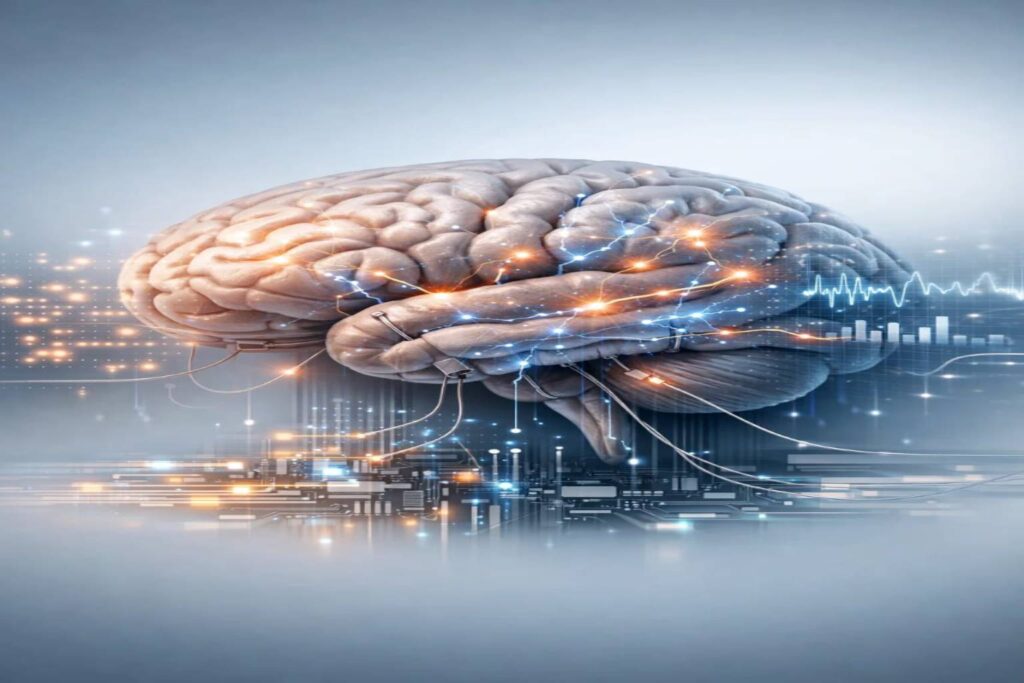
Increasingly, AI has made it possible to see ADHD not just as a behavioral condition but as a complex brain network variation.
– AI-powered MRI analysis detects atypical activity in the brain’s attention and reward centers.
– Machine learning can differentiate between ADHD subtypes, helping doctors personalize treatment and medication.
– In the near future, AI might even predict ADHD risk in children by analyzing sleep patterns, reaction times, and digital behavior data — allowing for early intervention and support.
Ethical Challenges Facing AI in Neuroscience
While the potential is enormous, the rise of neuro-AI raises ethical questions:
– Who owns brain data when it’s decoded by AI?
– How can we ensure privacy and consent?
– Could AI ever manipulate thoughts or emotions?
Looking forward, experts predict that within the next decade, AI could simulate entire brain processes, helping us understand consciousness, emotions, and creativity on a deeper level.
Conclusion
Yet, the human brain has always been the most complex mystery in science — until now.
With AI as our partner, we’re not just decoding it; we’re beginning to understand what makes us human.
As machine learning grows more sophisticated, the boundary between biology and technology will continue to blur. Yet, the goal remains simple: to improve lives, understand minds, and build a future where AI helps us unlock the full potential of the brain.
Key Takeaways
– AI and neuroscience together are transforming brain research and mental health.
– Deep learning algorithms help decode thoughts, emotions, and brain connectivity.
– AI in ADHD research allows for early detection and personalized treatment.
– Ethical frameworks are essential to protect brain data and privacy.
– The future of neuro-AI is promising — from medical breakthroughs to enhancing human cognition.
Frequently Asked Questions
AI analyzes brain data — like MRI scans, neural activity, and behavioral responses — at a scale and speed no human researcher could match. This helps identify patterns linked to conditions like Alzheimer’s, ADHD, and depression.
Not literally. However, AI can decode patterns in brain activity well enough to translate certain neural signals into text or control robotic limbs — which is different from reading thoughts directly.
AI-powered brain imaging can detect atypical activity in attention and reward centers, and machine learning is beginning to differentiate between ADHD subtypes to help personalize treatment.
Key concerns include who owns a person’s decoded brain data, and how to ensure informed consent. There’s also a deeper question: could AI eventually be used to influence thoughts and emotions, not just interpret them?
No. Instead, most experts see AI as a tool that helps researchers process massive datasets and spot patterns — not a replacement for the clinical judgment and experimental design human scientists provide.
References
- University of Texas at Austin — Brain Activity Decoder Can Reveal Stories in People’s Minds
- ScienceDirect — AI in Parkinson’s Disease: Early Detection and Diagnostic Advancements


